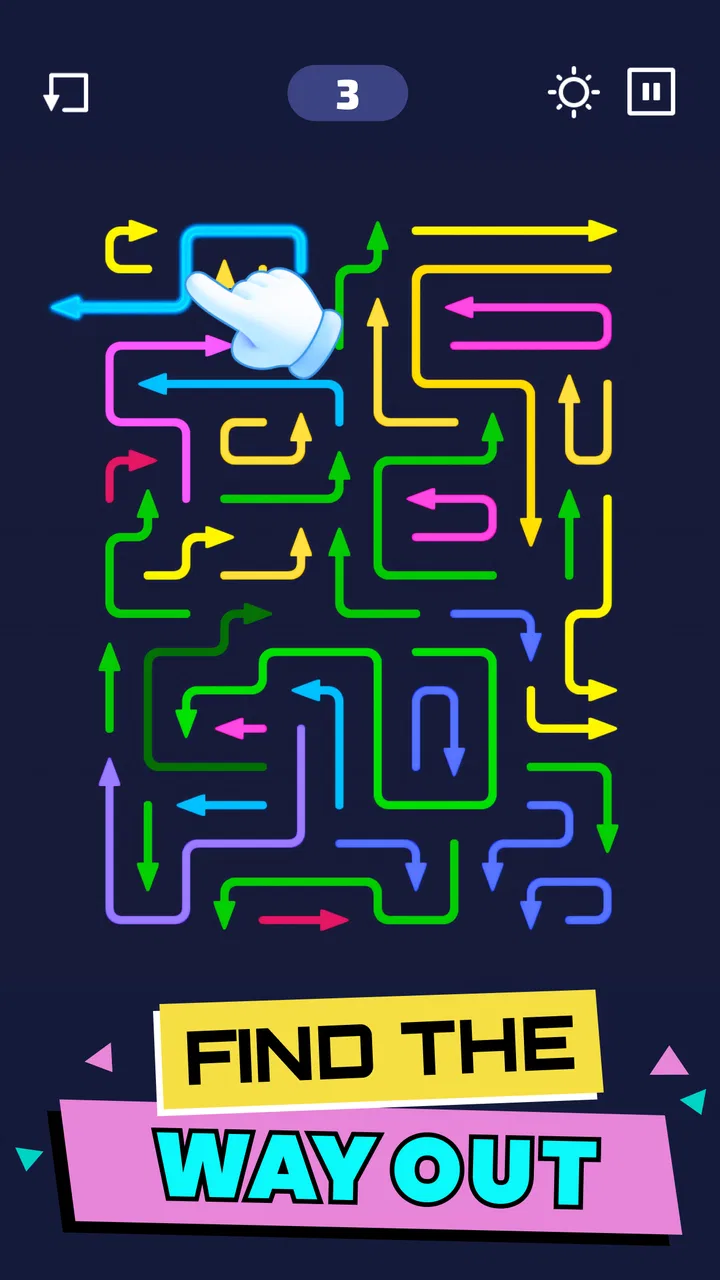
Redirect It! - Logic Puzzle
- 4.8
- Rating
- 5.00M
- Installs
- Free
- Price

 Analysis by App-foxy
I spent time with Arrow Maze - Escape Puzzle, a minimalist puzzle game from SayGames Ltd that turns a simple arrow-filled maze into a surprisingly careful exercise in planning. The idea is easy to understand: remove every arrow from the board, but do it in the right order so that each move opens a path instead of creating a dead end. It feels welcoming in the first few moments, yet the clean presentation hides the part that matters most: a small mistake can make a seemingly open maze impossible to finish.
That combination makes it a good fit for short breaks, quiet concentration, or anyone who enjoys puzzles that reward patience more than speed. I would not describe it as a large, story-driven game or a deep strategy experience. Its appeal is narrower and more focused. You look at a compact layout, identify the safe sequence, and enjoy the satisfaction of clearing it. For me, that direct loop is the strongest reason to try it, although players who need constant novelty or a more elaborate progression system may find it too restrained.
How the current version feels to play
The current release is version 1.8.2, and the game presents itself as a focused brain-training puzzle rather than an overloaded collection of modes. The board is the star. Arrows give the maze its rules, and the challenge comes from understanding how their directions interact with the available space. Instead of relying on complicated controls, the game asks me to observe, predict, and then commit to a move.
You May Also Like

 Blood Strike: 2.5 Anniversary
Blood Strike’s Loadouts Turn Every Drop Into a Tactical Gamble
A close look at Blood Strike’s custom loadouts: how fast access to signature weapons reshapes its battle royale rhythm, rewards preparation, and narrows the gap between fights.

 Pandora - Music & Podcasts
Pandora’s Music Is Easy to Start, but Harder to Recover
Pandora’s strength is its low-effort path from a seed to a station. Its weak spot is how much confidence it asks you to place in connection, setup, and quiet recovery.

 8 Ball Pool
 Is Built on Rivalries, Rematches, and Routine
A close look at the rivalries, rematches, shared routines, and unanswered safety questions that turn a quick pool match into a persistent mobile community.

 Samsung Music
’s Quiet Strength Is Playing What You Already Own
Its reach comes less from spectacle than from dependable access to a personal library. That simplicity is both the app’s strongest retention engine and its ceiling.

 AccuWeather: Weather Radar
AccuWeather Review: A Quick, Clear Forecast for Everyday Decisions
For everyday plans, the best forecast is the one you can understand quickly. AccuWeather makes rain timing, radar, and local conditions easy to act on, with a few trade-offs.

 Hill Climb Racing
Why Hill Climb Racing Still Turns Crashes Into One More Run
A tiny car, a bumpy hill and one more upgrade: Hill Climb Racing keeps resurfacing because its simple chaos makes every near-miss feel personal.
More From Our News Desk



That simplicity is useful on a phone. I can pick it up without remembering a long tutorial or learning several gestures. The visual language is also easy to read, which matters in a puzzle where the direction of an arrow is more important than decoration. A crowded interface would weaken this kind of game, so the minimalist approach works in its favor. I spend my attention on the arrangement in front of me rather than on menus or effects.
The most enjoyable part is the change in mindset from reacting to planning. In many casual puzzle games, the best move is obvious and the challenge is mostly repetition. Here, I often pause before touching the screen because the first arrow I notice is not necessarily the correct one to remove. I need to trace possible routes, consider which pieces are blocking others, and avoid treating the board as a collection of isolated objects.
That makes the game particularly suitable for a short mental reset. A quick session can feel more active than scrolling through social media, but it does not demand the time commitment of a traditional strategy game. I can play while waiting for an appointment or during a commute, provided I am somewhere I can concentrate. The puzzles are not ideal when I want something completely passive, because the enjoyment depends on giving the board my full attention for a few minutes.
The small decisions that make the maze interesting
One useful habit is to scan the edges before touching anything. An arrow with a clearly open route can look like an obvious first choice, but removing it may expose a more important blockage elsewhere. I found better results by looking for pieces whose movement would release several surrounding options. That approach turns each level into a compact exercise in prioritizing, not just matching direction with space.
I also learned not to restart too quickly. When a sequence goes wrong, the temptation is to assume the puzzle is lost and begin again immediately. Sometimes the board still contains a recoverable route, and checking the remaining arrows can reveal a way forward. This is a small but meaningful difference from games that encourage rapid retries. Arrow Maze rewards a slower review of the position, which gives the experience a calmer feel than many fast casual titles.
Another practical tip is to use the screen as a planning surface rather than tapping while thinking. I mentally group arrows by the paths they appear to control, then test the least disruptive option. This is especially helpful when several pieces point toward the same open area. The game does not need a complicated strategy guide; it benefits more from a disciplined routine: inspect, predict, move, and reassess.
What the minimalist design gets right
The stripped-back presentation supports the puzzle instead of competing with it. I never felt that the game needed a story or a decorative theme to justify its existence. The maze itself provides enough context, and the arrows communicate the central rule immediately. That makes the experience approachable for players who usually avoid puzzle games because they expect a long explanation before the fun begins.
It also makes the game accessible across different moods. I can play casually, making a few moves without trying to solve the whole board in advance, or I can treat a difficult layout as a proper logic problem. The same basic mechanics support both styles. That flexibility is one of the title's better qualities, because not every puzzle game works equally well for relaxed and focused play.
There is a trade-off, though. Minimalism can make a game feel less rewarding if the player wants a strong sense of place, character, or narrative progress. The satisfaction here comes almost entirely from solving the maze. If that feeling does not appeal to you, the clean design may seem empty rather than elegant. I would choose this over a more elaborate puzzle game when I want clarity, but I would choose a story-based alternative when I want emotional momentum or a larger world to explore.
Progress, audience, and practical value
Arrow Maze is free to install, with optional in-app purchases ranging from $0.99 to $14.99 per item. That makes it easy to test the core experience before deciding whether it deserves a place on your phone. I appreciate that approach for a compact puzzle game, because the central question is personal: do you enjoy studying arrow arrangements enough to return to them regularly?
The game is rated Everyone, and its premise is straightforward enough for a broad audience. Younger players can understand the basic objective, while adults may enjoy the concentration and pattern analysis. For children, I would still treat it as a game that benefits from occasional guidance, not because the rule is difficult, but because learning to plan several moves ahead can be frustrating at first. The clean controls reduce unnecessary barriers, but they do not remove the need for patience.
It requires Android 8.0 or later, so compatibility should be checked before installing it on an older device. On a supported phone, the modest presentation feels appropriate for a game designed around quick thinking rather than visual spectacle. I would not pick it for showing off a high-end display, but that is not what it is trying to do. Its value comes from being available for a focused puzzle whenever I have a spare moment.
The game has built a visible audience, with more than a million installs and an average rating of 4.8 from roughly fourteen thousand ratings. Those figures suggest that the straightforward concept connects with many players, but they should not replace personal judgment. A high rating cannot tell you whether the repetition will hold your attention. In my experience, the deciding factor is whether you enjoy solving ordered movement problems without needing a story or a large collection of mechanics.
How it compares with familiar puzzle alternatives
Compared with match-three games, this is less about quick visual recognition and more about sequencing. Match-three titles often let me make a move immediately and discover the result through chain reactions. Here, an impulsive action can be the problem. I need to think about consequences before I touch the board, so Arrow Maze feels better for deliberate players than for someone seeking constant animation and rapid rewards.
Compared with word puzzles, it exercises a different kind of attention. There is no vocabulary barrier and no need to search for a hidden phrase. The challenge is spatial and procedural: which arrow should move first, and what will that reveal? That makes it a useful alternative for someone who wants a puzzle they can understand without reading a lot, although word-game fans may miss the variety that language provides.
It is also more immediately approachable than many traditional logic games. A dense number-grid puzzle can require learning a set of formal rules, while the arrow maze communicates its basic idea visually. The downside is that the game may not offer the same sense of intellectual breadth as a larger logic collection. I would recommend it to someone who wants one clear mechanic polished around short sessions, not to someone searching for several distinct puzzle families in one app.
Everyday situations where it works best
My favorite use case is the awkward gap between tasks. If I have five quiet minutes before leaving home, I can open the game, solve a board, and stop without losing the thread of my day. It is more satisfying than filling the same gap with random browsing, yet it does not require headphones, a long setup, or a commitment to a full campaign. That makes it a practical companion for waiting rooms, short breaks, and similar moments.
It can also work as a concentration warm-up. Before studying or doing detail-heavy work, I sometimes prefer a small problem that requires orderly thinking. Clearing arrows encourages me to slow down and check consequences, which is a useful mental transition from distraction to focus. I would not claim that a casual game replaces a serious training method, but this particular loop is well suited to waking up the part of my attention that handles sequences and spatial relationships.
Families may find it useful as a shared puzzle, too. One person can suggest a move while another controls the board, creating a simple conversation about possibilities. That is more enjoyable than silently watching someone play because the maze naturally invites explanations: why remove this arrow first, and what route does it open? The game is less suitable for a group that wants fast competition, since its pleasure comes from careful solving rather than racing.
Where the experience still has limits
The biggest limitation is the narrowness of the central idea. Arrow removal is clean and understandable, but it cannot appeal to everyone indefinitely. If you prefer games that constantly introduce new characters, tools, or puzzle rules, the focused design may begin to feel repetitive. I would especially hesitate to recommend it to players who measure value by the size of a campaign or the number of different modes available.
There is also a natural tension between accessibility and depth. Because the rule is easy to grasp, the game can welcome people who are new to logic puzzles. But a player who already spends a lot of time with complex spatial games may want more layers than the arrow-and-maze format provides. The challenge can still be satisfying, yet the ceiling depends heavily on how much variety the layouts deliver over time.
The free entry point is convenient, but optional purchases are worth considering as part of the overall experience. With individual items priced from $0.99 up to $14.99, I would approach spending cautiously and decide whether any purchase improves the way I actually play. For me, the sensible method is to use the free version long enough to learn whether the basic loop remains enjoyable. A purchase should support an established habit, not be used to rescue a game that already feels repetitive.
Another limitation is that the game asks for genuine concentration despite its casual appearance. Someone looking for a background activity may find it frustrating because the correct sequence is the entertainment. If you are multitasking, you may make mistakes that are not caused by poor design but by divided attention. In that situation, a simple idle game or an action title may be a better fit.
What the release history tells me
The game was released on October 17, 2025, and its current version is 1.8.2. That gives the product a relatively recent starting point and shows that it has already moved beyond its first release build. I see that as a positive sign for a game whose long-term appeal depends on maintaining a steady supply of worthwhile puzzle situations, although the version number alone does not tell me exactly which parts of the experience changed.
For existing players, the important question is whether updates preserve the clean core while improving the surrounding experience. I would rather see careful refinement of board readability, control reliability, and progression than unnecessary features that distract from the maze. A puzzle game benefits from consistency: returning players should understand the rules immediately, while still finding enough new thinking challenges to justify another session.
New users can approach the current build without needing to know how the game looked at launch. The useful starting point is simply to test the first several sessions and notice how the difficulty feels. If the puzzles encourage you to plan more carefully without becoming opaque, the current version is doing its job. If you find yourself tapping randomly or restarting out of irritation, the format may not suit your preferred style, regardless of later refinements.
Who should try it and what to watch next
I recommend Arrow Maze to players who like compact spatial puzzles, prefer clear rules, and enjoy the moment when a complicated-looking board suddenly becomes understandable. It is especially good for short, focused sessions and for people who want a calmer alternative to reflex-heavy mobile games. The Everyone rating and simple premise make it approachable, while the need to plan gives it more substance than a purely disposable time-filler.
I would skip it if you need a strong narrative, competitive multiplayer, constant mechanical change, or a game that can be played without thinking. I would also choose a broader puzzle collection if I knew I wanted several different challenge types rather than one carefully defined idea. Arrow Maze is at its best when its limitations are treated as part of the appeal: one rule, one board, and the satisfaction of finding the correct order.
When deciding whether to keep it installed, I suggest paying attention to three things during your first sessions. First, do you enjoy planning before tapping? Second, does solving a board feel rewarding even without a story or elaborate presentation? Third, do you naturally return after taking a break, or does the same format already feel familiar? Those answers are more useful than any general recommendation because this game depends so strongly on personal puzzle taste.
I will be watching how SayGames Ltd develops the experience from version 1.8.2 onward, particularly whether future changes add meaningful variety without making the interface noisy or the rules harder to read. The best direction would preserve the instant understanding that makes the game approachable while giving committed players fresh reasons to examine each maze carefully. The core idea is simple, but its success depends on thoughtful level variety and a fair sense of progression.
Overall, I found it easy to recommend as a free puzzle to test, not as an all-purpose mobile game. Arrow Maze - Escape Puzzle earns its place through focused design, readable challenges, and the quiet satisfaction of solving a sequence that initially looks blocked. It will not replace a deep logic collection for serious puzzle enthusiasts, but for a quick mental workout with no complicated entry barrier, it is a polished and appealing choice.
FAQs for Redirect It! - Logic Puzzle
01What is the main objective of Arrow Maze - Escape Puzzle?
Arrow Maze - Escape Puzzle challenges players to navigate through intricate mazes by strategically placing and adjusting arrows to guide their character to the exit. Each level presents a unique puzzle that requires logical thinking and precise planning to complete successfully. The game offers a mix of strategy and skill, keeping players engaged as they advance through increasingly complex stages.
02Is Arrow Maze - Escape Puzzle suitable for all age groups?
Yes, Arrow Maze - Escape Puzzle is designed to be accessible and enjoyable for a wide range of age groups. The game’s intuitive controls and simple mechanics make it easy for younger players to understand, while the progressively challenging levels provide ample puzzle-solving fun for older audiences. It’s a family-friendly game that encourages critical thinking and patience.
03Does Arrow Maze - Escape Puzzle require an internet connection to play?
Arrow Maze - Escape Puzzle can be played offline, making it a great option for on-the-go entertainment without the need for an internet connection. However, some features, such as leaderboard access and updates, may require an internet connection to function. Players can enjoy the core gameplay anywhere, anytime, without worrying about connectivity issues.
04Are there in-app purchases in Arrow Maze - Escape Puzzle?
Yes, Arrow Maze - Escape Puzzle includes optional in-app purchases that allow players to enhance their gameplay experience. These purchases might include additional levels, hints, or cosmetic upgrades. While the game can be enjoyed fully without spending money, these options offer players the ability to customize and expand their experience if they choose.
05What platforms is Arrow Maze - Escape Puzzle available on?
Arrow Maze - Escape Puzzle is available for both Android and iOS devices. Players can download the game from the Google Play Store or the Apple App Store, ensuring compatibility with a wide range of smartphones and tablets. Regular updates are provided to enhance performance and introduce new features, keeping the game fresh and exciting.
Pros
- Challenging puzzles enhance problem-solving skills.
- Visually appealing graphics keep players engaged.
- Intuitive controls for easy navigation.
- Regular updates with new levels and features.
- No intrusive ads for uninterrupted gameplay.
Cons
- Limited hints may frustrate casual players.
- Some levels feel repetitive over time.
- Requires internet for certain features.
- Battery consumption can be high during play.
- Occasional lag on older devices.

Redirect It! - Logic Puzzle
Gallery